There are no items in your cart
Add More
Add More
| Item Details | Price | ||
|---|---|---|---|

Grounded theory (GT) is a general research methodology for systematically generating theory from data.
Rather than beginning with a theory to test or a conceptual framework that determines what to look for, grounded theory uses systematic data collection and analysis to discover conceptual concepts and their relationships.
The goal is to generate a theory that explains what is happening in a substantive area, particularly a main concern of participants, and how they recurrently address that concern.
Grounded theory can be used with different types of data, including qualitative and quantitative data. Although it is frequently used in qualitative research, GT is not simply a qualitative data-analysis technique.
Grounded theory is about generating theory—not simply finding themes.
A thematic analysis identifies and describes patterns or themes within a dataset.
Grounded theory goes further. Through the constant comparative method of analysis, the researcher moves from incidents in the data to concepts and categories, ultimately developing an integrated theoretical explanation.
The question is not simply: “What themes are present in these data?”
Instead, the researcher is continually asking questions such as:
The resulting theory explains a pattern of behavior used by people in the substantive area to address a recurring concern or problem, rather than simply describing what participants said or did or identifying themes.
The term "grounded theory" is now used to describe various approaches developed since Drs. Barney Glaser and Anselm Strauss first developed grounded theory in the 1960s. Dr. Glaser continued to teach and write about the original version, which is commonly called classic grounded theory. At RTM, we refer to Glaser's work as Glaserian classic grounded theory (GCGT). Glaserian classic grounded theory has a distinctive methodological logic and set of procedures. It should not be assumed that a study described simply as "grounded theory" follows the classic GT approach.
Glaserian classic grounded theory is characterized by several core principles:
A central focus of Glaserian classic grounded theory is identifying the main concern in the substantive area and the recurrent way in which participants address it.
Glaserian classic grounded theory differs from approaches that begin with a predetermined theoretical framework, emphasize the co-construction of meaning between researcher and participant, or use prescribed coding procedures that are not part of Glaser's original methodology.
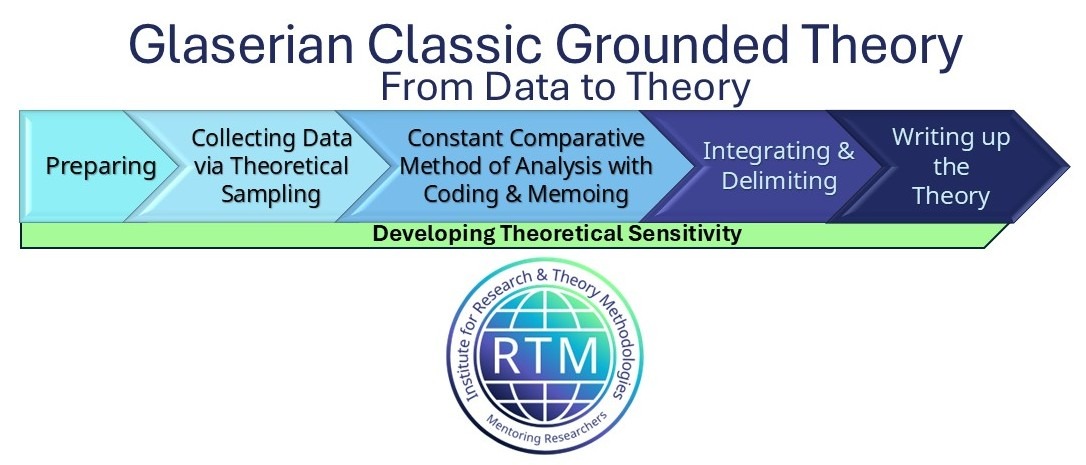
A Glaserian classic grounded theory study is best understood as a dynamic research process, not as a rigid sequence of independent steps. RTM describes the process in five broad stages:
The stages provide a useful way to understand the overall process, but the activities within them overlap and inform one another. Data collection, analysis, and memoing, for example, continually interact as the theory emerges.
Glaserian classic grounded theory begins with an area of interest rather than a predetermined theory that the researcher intends to impose on the data.
The researcher prepares by developing theoretical sensitivity and minimizing preconceptions that could prevent concepts from emerging from the data.
The researcher may begin with a broad research interest or substantive area, but does not need to know in advance exactly what the final theory will explain.
This is an important distinction from approaches in which the researcher begins by establishing a detailed conceptual framework and then collects data to test or confirm it.
What happens during preparation?
The researcher:
A GCGT study does not require the researcher to begin with a highly specific question that determines what the study must find.
Instead, the researcher begins with an area of interest and allows the research process to identify what is actually happening in that area.
As the analysis develops, the emerging theory becomes increasingly focused.
What about the literature review?
GCGT approaches the literature differently from research designs that begin with an extensive literature review and use that literature to construct a conceptual framework before collecting data.
The researcher seeks to minimize the risk that existing concepts will become theoretical preconceptions that determine what is seen in the data.
Relevant literature can later be brought into the developing theory and compared with the emerging concepts and relationships.
In Glaserian classic grounded theory, data collection is guided by the emerging analysis.
The researcher begins collecting data in an area relevant to the research interest. As concepts and categories begin to emerge, the researcher uses theoretical sampling to determine what data should be collected next.
Theoretical sampling means collecting data for the purpose of developing the emerging theory.
It is not simply a matter of deciding in advance how many participants are needed.
How theoretical sampling works
The process can be understood as:
Collect data → Analyze → Identify what needs to be understood → Sample for that theoretical need → Collect more data → Analyze again
For example, an emerging category may raise questions that cannot be answered by the data already collected.
The researcher then seeks additional data that will help develop the category, explore its properties and dimensions, or clarify its relationship with other categories.
The emerging theory, therefore, increasingly guides where the researcher goes next.
Theoretical sampling continues until theoretical saturation
Theoretical saturation occurs when additional data no longer contribute substantially to the development of the relevant theoretical categories, their properties, and relationships.
Theoretical saturation is therefore connected to the emerging theory, not simply to reaching a predetermined number of interviews.
Theoretical sampling → Emerging analysis → Theoretical saturation
Data analysis in Glaserian classic grounded theory occurs throughout the research process rather than being postponed until all data have been collected.
The central analytic process is the constant comparative method of analysis.
The researcher continually compares incidents with incidents, incidents with codes, codes with codes, and emerging concepts and categories with one another.
The purpose is to discover patterns, similarities, differences, properties, dimensions, and relationships that help explain what is happening in the substantive area.
Coding is the process of conceptualizing what is happening in the data.
GCGT begins with substantive coding.
Substantive codes identify what is happening in the substantive area and provide the building blocks for developing concepts and categories.
As the analysis progresses, the researcher identifies increasingly significant concepts and categories and begins to focus the analysis around the emerging core category and its relationship to other categories.
The researcher is not simply assigning descriptive labels to pieces of text. Coding is part of the process of moving from empirical data toward conceptual understanding.
Memoing is the process of writing down theoretical ideas as they emerge. Memos capture the researcher's developing thoughts about:
Data collection, analysis, and memoing are ongoing and interact throughout the study.
As the analysis progresses, the researcher moves from developing individual concepts and categories toward integrating them into an explanatory theory. This stage includes sorting, theoretical coding, and development of the theoretical outline.
Once substantial theoretical ideas have accumulated, the researcher begins sorting the memos.
Sorting is not simply organizing or categorizing raw data.
It is a conceptual process in which memos are examined and organized in relation to one another to identify the structure and relationships of the emerging theory.
Sorting can generate additional theoretical insights and may lead to further memoing or, when necessary, additional theoretical sampling.
Theoretical coding is the process of conceptualizing relationships among substantive categories during sorting memos so that they can be integrated into a theory.
The researcher considers how categories relate to one another and what theoretical pattern best explains those relationships.
Theoretical codes provide conceptual ways to organize and explain relationships among categories. They are not a predetermined coding template that the researcher applies to the data.
Instead, theoretical coding is used to help discover and articulate the emerging theoretical structure of the theory.
The theoretical outline organizes the major concepts and their relationships into the developing structure of the theory. The memos are then sorted into the outline. At this point, the researcher is moving toward an integrated explanation rather than a collection of separate categories.
As the theory becomes integrated, the researcher delimits it. Delimiting means progressively focusing the theory around what is most relevant to explaining the core category. The researcher is not attempting to explain everything that could possibly be related to the substantive area. Instead, the theory becomes increasingly focused, parsimonious, and bounded.
The final stage is writing the emerging theory.
The completed theoretical sort into the theoretical outline provides the conceptual structure for the written theory.
The researcher organizes the theory so that the reader can understand:
A Glaserian Classic Grounded Theory Study Is Not a Straight Line
Although the five stages provide a useful overview, Glaserian classic grounded theory is not a simple five-step recipe.
The researcher moves between activities as the theory develops.
For example:
Data collection may lead to a new code.
A code may suggest a developing category.
A category may raise a theoretical question.
That question may lead to theoretical sampling.
New data may change the understanding of the category.
Memoing may reveal a relationship between categories.
Sorting may generate another theoretical insight.
The researcher then returns to the data, analysis, memoing, or sampling as needed.
This iterative movement is part of how the theory emerges.
A Glaserian Classic Grounded Theory Study Is Not a Straight Line
Although the five stages provide a useful overview, Glaserian classic grounded theory is not a simple five-step recipe. The researcher moves between activities as the theory develops.
For example:
This iterative movement is part of how the theory emerges.
Several features are particularly important to understanding Glaserian classic grounded theory.
It seeks to discover rather than impose.
The researcher works to minimize preconceptions so that concepts and relationships can emerge from the data.
It is conceptual rather than primarily descriptive.
The goal is not simply to describe participants' experiences or organize their accounts into themes. The goal is to develop a theory composed of concepts and categories grounded in data that explain what is happening.
Data collection follows the emerging theory.
Theoretical sampling means that decisions about what data to collect next are informed by the developing analysis.
Analysis begins early.
The researcher does not wait until all data have been collected before beginning analysis.
The theory develops through constant comparison.
The constant comparative method of analysis continually tests and develops emerging concepts and categories against new incidents and against one another.
The theory becomes integrated and delimited.
The final theory is not a list of categories. Categories are integrated through theoretical relationships, and the theory is delimited around what is most relevant to explaining the central pattern.
Not quite. Themes can summarize patterns in data. Classic GT seeks to generate an explanatory theory through conceptualization, constant comparison, theoretical sampling, memoing, and theoretical integration.
No. Classic GT relies on emergence. Categories develop through systematic analysis rather than being established in advance.
"I need to interview a specific number of people."
Not necessarily. The amount of data needed depends on what is required to develop the emerging theory. Theoretical sampling and theoretical saturation guide decisions about additional data collection.
"I collect all my data first and analyze it afterward."
No. Data collection and analysis interact throughout the study.
"The literature review tells me what concepts I should look for."
Not in classic GT. Existing literature can become a source of theoretical preconception if it is used to impose a conceptual framework on the study. Classic GT approaches the literature in a way that protects the emergence of theory.
Relevant literature can subsequently be integrated with the emerging theory.
"Grounded theory requires a particular qualitative data-analysis software."
No. Software may be used as a practical organizational tool, but it is not what makes a study grounded theory. The method rests on the researcher's conceptual work: constant comparison, coding, memoing, theoretical sampling, theoretical coding, sorting, integration, and delimiting.
Glaserian Classic Grounded Theory may be appropriate when your goal is to discover and explain a recurring pattern of action or a process in a substantive area. It may be particularly useful when:
 Launch your Graphy