There are no items in your cart
Add More
Add More
| Item Details | Price | ||
|---|---|---|---|

Qualitative inquiry has never been one voice.
It has always emerged from people seeking to understand human experience within particular communities, cultures, relationships, places, histories, and circumstances. The questions we ask, the ways we listen, what we notice, and how we make sense of what we learn are shaped by the worlds in which we conduct research.
Yet academic conversations about qualitative research can sometimes make it sound as though there is one shared way of doing qualitative inquiry.
There isn’t.
There are many voices.
And those voices matter.
Researchers often develop within particular academic communities. We learn from our mentors, our institutions, our disciplines, and the scholars whose work we encounter.
Those communities are important. But they can also become boundaries.
We may become familiar with certain approaches while remaining largely unaware of others. We may assume that the questions we consider important are important everywhere. We may encounter research traditions through the lens of our own assumptions rather than taking the time to understand them on their own terms.
What happens when we listen beyond those boundaries?
We encounter different ways of understanding experience.
Different relationships between the researcher and the participant.
Different understandings of community.
Different approaches to knowledge.
Different traditions for making sense of the social world.
And sometimes, we discover that a question we thought we understood looks very different from somewhere else.
The word community can sometimes suggest that everyone within it thinks alike.
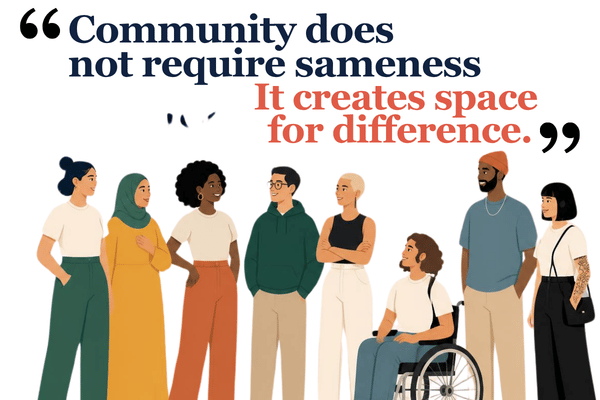
But a strong research community does not require sameness.
It creates space for difference.
The 2026 ic-QRTM theme, Voices in Community: Weaving Qualitative Inquiry Across Lands & Traditions, is grounded in this idea.
To weave qualitative inquiry across lands and traditions is not to erase differences or combine every approach into one.
It is to create opportunities for researchers to encounter one another’s work, listen carefully to different perspectives, and consider what those differences might teach us.
Some of the most valuable scholarly conversations happen when we discover that another researcher is seeing something we could not see from where we were standing.
A global research community is not one voice speaking to the world. It is many voices learning to listen to one another.
If qualitative inquiry is shaped by context, then a truly global conversation about qualitative research needs researchers from many contexts.
It needs researchers whose work emerges from different countries and communities.
It needs students and experienced scholars.
It needs researchers working across disciplines.
It needs different methodological traditions.
It needs voices that are well established in academic conversations and voices that have not always had easy access to those conversations.
This is one of the possibilities of bringing qualitative researchers together across lands and traditions.
We don’t simply expand the number of people in the conversation.
We expand what can be heard.
This October, ic-QRTM will bring researchers together for its third year using its month-long YouTube conference format.
For 30 days, presentations will be available for researchers, students, educators, and others to explore from wherever they are.
The format gives us something that a traditional conference schedule often cannot: time to listen beyond our immediate interests.
You can watch a presentation from a researcher whose work you already know.
Then choose one from a country, discipline, or tradition that is unfamiliar to you.
You can follow a line of inquiry that takes you somewhere unexpected.
You can return to a presentation later.
You can share it with a colleague or student.
And you can become part of a global community of qualitative researchers without having to leave your own community.
The 2026 ic-QRTM theme is an invitation.
An invitation to listen.
An invitation to share.
An invitation to encounter qualitative inquiry as something larger than any single discipline, country, tradition, or perspective.
Voices in Community: Weaving Qualitative Inquiry Across Lands & Traditions
Because qualitative inquiry becomes richer when more voices can be heard.
Join us for 30 Days of Insight.
One Global Community.
Zero Barriers.
 Launch your Graphy