There are no items in your cart
Add More
Add More
| Item Details | Price | ||
|---|---|---|---|


You’d think by now, after decades of scholarship, we’d have settled the whole “mixed methods vs. multi-method” terminology.
Spoiler alert: we haven’t.
December 03, 2025

Here’s why: the language we use shapes how we design studies, teach students, and justify our choices to funders and journals. If I tell a grant panel I’m doing “mixed methods” but actually mean “multi-method,” I’m signaling a level of paradigm integration that my design might not deliver. That can create mismatched expectations and even credibility problems.
Recent scholarship (e.g., Guetterman et al., 2024; Fàbregues & Guetterman, 2025) highlights that integration (not just mixing for the sake of it) is the gold standard for mixed methods. Multi-method, meanwhile, is a powerful approach in its own right, especially for depth or triangulation within one paradigm. And mixed data? That’s often a pragmatic reality in big datasets, but it doesn’t automatically mean you’ve done mixed methods research.
The persistent fuzziness traces back to the 1970s and 1980s. Back then, “triangulation” was the buzzword, and many thought any combination of methods qualified as “mixed.” Over time, thought leaders such as Greene (1989, 2007) and Creswell (2018) have clarified distinctions, but habits die hard, especially across disciplines.
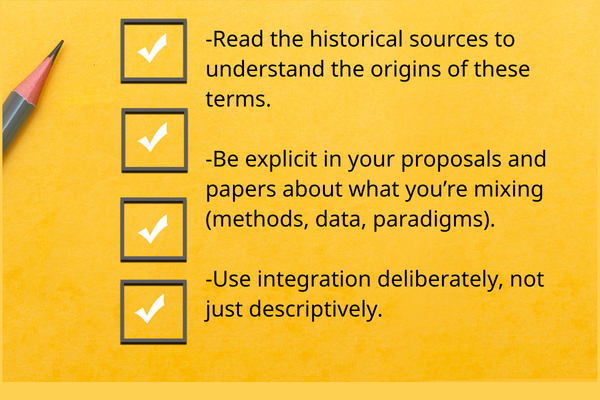
If you’re a PhD student or early-career researcher, here’s my advice:
Clarity in terminology isn’t pedantic; it’s methodological rigor. And in a field where methods debates can shape publication outcomes, that clarity could be the difference between a smooth peer review and a desk rejection.
 Launch your Graphy