There are no items in your cart
Add More
Add More
| Item Details | Price | ||
|---|---|---|---|

Thu Nov 20, 2025
If you’ve ever sat in a research methods seminar and felt your head spin when people toss around “mixed methods,” “multi-method,” and “mixed data” like they’re the same thing… you’re not alone. Even seasoned scholars sometimes blur the boundaries. The good news? Each term has a distinct history and purpose.
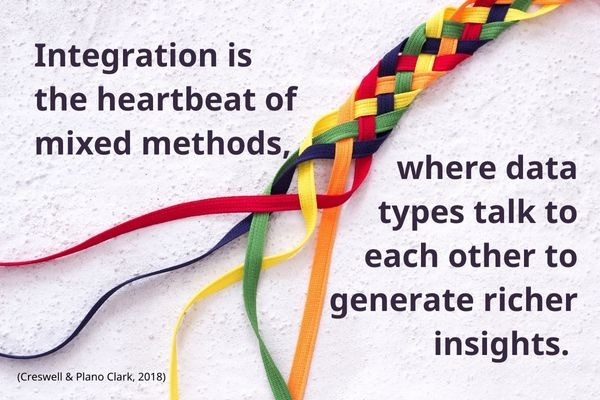
Mixed methods is the most well-known. It refers to a single study that intentionally integrates both qualitative and quantitative approaches, not just collecting both, but actually weaving them together at various stages (design, analysis, interpretation). Creswell and Plano Clark (2018) define integration as the heartbeat of mixed methods, where data types talk to each other to generate richer insights.
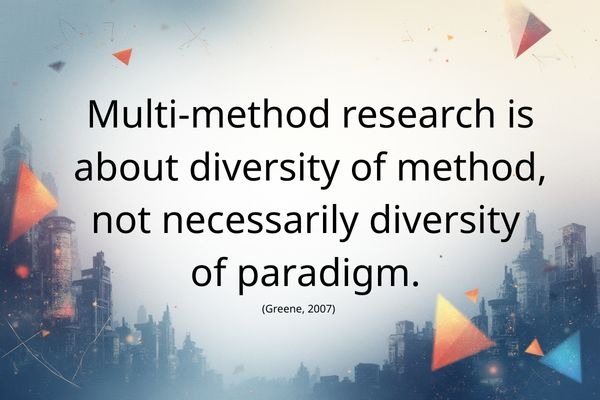
Multi-method research is different. It still employs more than one method, but they can be within the same paradigm, such as two qualitative methods or two quantitative ones. Think interviews plus participant observation, or surveys plus experiments. Greene (2007) and others have been clear: it’s about diversity of method, not necessarily diversity of paradigm.
Mixed data is a term you’ll hear less often in formal textbooks, but it’s increasingly discussed in applied fields. It means that your dataset itself contains both qualitative and quantitative elements, such as survey responses with open-ended text alongside numeric ratings. You might analyze them together or separately, but the “mix” exists at the data level rather than in your overall research design.
The confusion partly comes from the historical evolution of mixed methods as a field. Early on, especially after Denzin’s (1978) discussion of triangulation, researchers often used “multi-method” and “mixed methods” interchangeably. However, as methodological debates matured, especially in the 1980s and 2000s, leaders like Greene and Creswell advocated for sharper definitions.
So, when planning your own research, be precise: Are you integrating across paradigms (mixed methods)? Are you diversifying approaches within a paradigm (multi-method)? Or are you working with inherently varied data formats (mixed data)? Clear language not only strengthens your methodology; it also makes peer reviewers smile.
 Launch your Graphy